

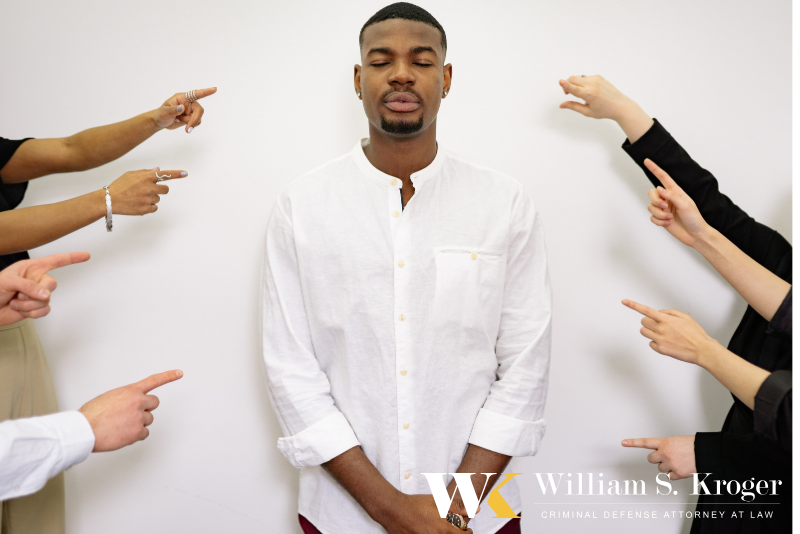
False accusations lead to real arrests, real charges, and real criminal records in California. Prosecutors can file a case based on one person’s statement, and what you say in the first few days often shapes everything that follows. If you’re asking, “How can I defend myself against false accusations?” the answer begins long before anyone sets a trial date.
At William S. Kroger Criminal Defense Attorney at Law, our team has defended clients across Los Angeles in more than 10,000 criminal cases. We know how detectives build cases around a single accuser and how to take those cases apart. We also explain each stage of the process so you always know what comes next.
Keep reading to learn how to protect yourself, which mistakes to avoid, and how we fight false allegations. You don’t have to return that detective’s call until you’ve spoken with us.
Why People Make False Accusations in Los Angeles Criminal Cases
False accusations rarely come out of nowhere. In our experience, they usually grow out of a conflict, a misunderstanding, or a reason to shift blame onto someone else. Understanding the motive behind the accusation tells us where to start digging.
The most common motives we see include the following:
- Custody or divorce leverage: A parent may allege abuse to gain an advantage in a family court dispute or to secure a restraining order.
- Revenge after a breakup: An ex-partner may report a crime that never happened out of anger or jealousy.
- Covering their own conduct: Someone who started a fight or took property may accuse you first to avoid scrutiny.
- Mistaken identity: An honest witness may pick the wrong person from a lineup or a blurry security video.
- Financial gain: An accuser may hope to pressure you into paying money to make the problem disappear.
Each of these motives leaves a trail, and we work to find it.
For example, a client might be accused of assault days after filing for custody of a shared child. The timing alone gives us a reason to request the accuser’s family court filings and recent messages.
Steps to Protect Yourself Before Charges Are Filed
Many people learn about an accusation before the Los Angeles County district attorney decides whether to file charges. This window is valuable because evidence is fresh and no formal case exists yet. Take these actions as soon as you learn about the allegation:
- Stay silent with police. The Fifth Amendment protects your right to refuse questioning, and you can politely decline an interview until you have a lawyer.
- Avoid all contact with the accuser. Even a friendly message can look like intimidation or an attempt to influence a witness.
- Preserve every record. Save text messages, emails, social media posts, call logs, and phone location history before anything is deleted.
- Write down a timeline. Record where you were, who you were with, and what happened while your memory is still clear.
- Identify potential witnesses. List anyone who saw you, spoke with you, or can confirm your whereabouts at the relevant time.
- Follow any protective order exactly. Under California Penal Code § 273.6, knowingly violating a protective order is a separate crime punishable by up to 1 year in county jail, a fine of up to $1,000, or both.
These steps protect your position while we begin our own investigation.
Mistakes That Make a False Accusation Harder to Fight
Innocent people often hurt their own cases because they assume the truth will speak for itself. Detectives who ask you to “tell your side” are usually gathering statements they can use in a prosecution. Any detail you get wrong, even by accident, can later be framed as dishonesty.
Social media creates similar problems. Posts about the accuser, the relationship, or the investigation can be screenshotted and shown to a judge or jury. Deleting old messages is just as risky, since it can look like you are hiding evidence.
Avoid asking friends or relatives to talk to the accuser on your behalf. Prosecutors may view these conversations as an effort to pressure a witness, which can lead to additional charges. We handle all communication about the case so nothing you or your family does can be turned against you.
How We Build a Defense Against False Accusations
Defending against a false accusation means showing that the story doesn’t hold up. Our team prepares every case as if it is going to trial, which forces us to test each piece of the accuser’s account. At William S. Kroger Criminal Defense Attorney at Law, that work starts the day you call us.
Pre-Filing Investigation
When we get involved before charges are filed, we can sometimes stop a case before it starts. Our team gathers evidence, interviews witnesses, and presents information to the district attorney (DA) that undercuts the accusation. Los Angeles County prosecutors are less likely to file charges when they see a case with serious credibility problems.
A pre-filing investigation also locks down evidence early. Surveillance footage is often erased within weeks, and phone records can become harder to obtain over time. We move quickly so that evidence is still available when we need it.
Using Discovery to Test the Accuser’s Story
Once charges are filed, the prosecution must share key evidence with the defense through a process called discovery. Under California Penal Code § 1054.1, prosecutors must disclose witness statements, relevant physical evidence, and exculpatory evidence, meaning evidence that points toward innocence. We review every page of that material for gaps, contradictions, and missing pieces.
Discovery often reveals details the accuser left out of the first police report. A timeline that shifts between interviews can change how a judge or jury views the entire case.
Challenging the Accuser’s Credibility
In a false accusation case, the accuser’s credibility is often the whole case. California Evidence Code § 780 allows jurors to consider a witness’s bias, motive to lie, and prior statements that conflict with their testimony. We use cross-examination to put each of those factors in front of the jury.
For example, an accuser might tell police one version of events and text a friend a different version the same night. We present both. Inconsistencies like these give jurors a concrete reason to doubt the accusation.
Alibi and Digital Evidence
Modern devices create a detailed record of where people go and what they do. Global Positioning System (GPS) data, rideshare receipts, card transactions, and building access logs can place you somewhere else at the time of the alleged crime. When the people holding these records won’t release them, we obtain them through subpoenas, which are court orders requiring someone to produce evidence.
Digital evidence can also undercut the accuser’s version of events. Messages sent before and after the alleged incident often show a tone or relationship that contradicts what the accuser later told police.
The Prosecution Still Carries the Burden of Proof
You don’t have to prove your innocence in a California criminal case. Under Penal Code § 1096, every defendant is presumed innocent, and the prosecution must prove guilt beyond a reasonable doubt. If the evidence leaves jurors with a reasonable doubt, you are entitled to an acquittal, meaning a not guilty verdict.
False accusation cases carry a specific risk, though. Under California Evidence Code § 411, the direct testimony of one witness who is entitled to full credit can prove any fact. A conviction can rest on the accuser’s word alone if the jury believes them, which is why we focus so heavily on credibility.
Can the Person Who Lied Face Charges?
Many clients want to know whether the accuser will face consequences. California law does make false reporting a crime. Under Penal Code § 148.5, knowingly making a false report of a felony or misdemeanor to police or a prosecutor is a misdemeanor.
An accuser who repeats the false story under oath faces more serious exposure. Penal Code § 118 defines perjury as willfully stating something material under oath while knowing it is false. The decision to charge the accuser belongs to prosecutors.
Our focus stays on your defense. The same evidence that exposes a false report in court protects your freedom first.
Clearing Your Name After a False Arrest
An arrest record can follow you even when charges are never filed or are later dismissed. California offers a remedy built for this situation: A petition for a finding of factual innocence. Under Penal Code § 851.8, you can ask the court to find that no reasonable cause exists to believe you committed the offense.
If the court grants the petition, your arrest records are sealed for 3 years and then destroyed. Under the same statute, you generally must file within 2 years of the arrest or the filing of charges, whichever is later. Our team at William S. Kroger Criminal Defense Attorney at Law reviews every dismissed or unfiled Los Angeles case to see whether a factual innocence petition makes sense.
Frequently Asked Questions
Clients facing false allegations often ask us these questions.
Can the accuser drop the charges in California?
No, only the prosecutor can dismiss a case once charges are filed. An accuser’s recantation or refusal to cooperate can still weaken the prosecution’s evidence significantly.
Should I take a polygraph if I’m falsely accused in Los Angeles?
Polygraph results are inadmissible in California criminal proceedings unless all parties agree, under Evidence Code § 351.1. We sometimes arrange a private polygraph to help persuade prosecutors before charges are filed.
Can I be convicted based only on one person’s word?
Yes, California law allows one credible witness to prove any fact. That is why we focus on exposing bias, inconsistent statements, and motives to lie.
Should I meet with detectives to explain my side?
Not without a lawyer present. We can speak with detectives for you, which protects your Fifth Amendment rights while still putting helpful evidence in front of investigators.
What happens if I text the person who accused me?
Contacting the accuser can lead to new charges, especially if a protective order is in place. Let us handle all communication so your messages can’t be used against you.
Defend Yourself Against False Accusations With William S. Kroger
Under California law, one credible witness can prove any fact, so a convincing lie can become a conviction. Our job is to make sure that never happens to you.
Our attorneys have handled more than 10,000 criminal cases throughout California, with over 75 years of combined criminal defense experience. Attorney William S. Kroger and our team have obtained dismissals in serious felony matters and won not guilty verdicts at trial. Recognition from Super Lawyers and the American Institute of Criminal Defense Attorneys reflects that record.
We walk you through every stage of the case so you’re never guessing what comes next. Spanish-speaking clients can work with interpreters whenever needed. From the first call, we work to stop the accusation before it becomes a charge and to beat it in court if it does.
Call (323) 655-5700 or reach us through our contact page to schedule your free case evaluation with our Los Angeles team.