

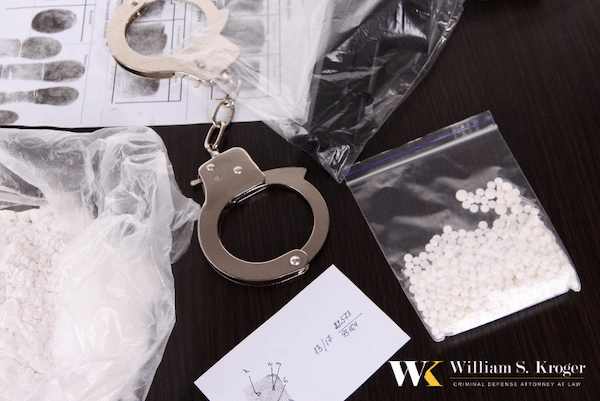
You walked out of booking with a citation in your hand and a court date you did not ask for. The fear of jail, a permanent record, and hard questions from family can feel overwhelming right now. What you do in the next few days can shape the entire outcome of your case.
A drug possession charge in Los Angeles falls under California Health and Safety Code 11350 and related laws. A conviction can follow you into job applications, housing, professional licensing, and immigration decisions. The decisions you make before your first court date often matter as much as anything that happens later.
At William S. Kroger Criminal Defense Attorney At Law, we defend people across Los Angeles who are facing drug possession charges. Our drug crimes lawyers in Los Angeles know how local prosecutors build these cases, and we know where they tend to fall apart.
The right strategy can mean reduced charges, a dismissal, or a path that keeps a conviction off your record. From the first moves after an arrest to the defenses and diversion programs available to you, here is what you need to know. If you need legal help, contact our office today to explore your options.
What to Do Immediately After a Drug Possession Arrest
The hours and days after an arrest are the most important part of your defense. What you say to police, whether you agree to a search, and how fast you get legal help can change the charges you face. Careful choices protect your rights and give us more to work with later.
If you have been arrested for drug possession in Los Angeles, take the following steps to protect yourself:
- Stay silent beyond giving your name. You do not have to explain the drugs, answer questions, or justify where you were.
- Do not consent to a search. When officers search without a warrant or your permission, we may be able to challenge whatever they find.
- Avoid apologizing or making excuses. Statements that feel harmless can be used as proof that you knew about the substance.
- Write down everything you remember. Note the time, the location, what officers said, and how the search unfolded while it is fresh.
- Preserve any prescriptions. If a drug was legally yours, save the bottle, pharmacy records, and your doctor’s information.
- Call a defense attorney before talking to investigators. We can speak with the prosecution for you and keep you from saying something damaging.
Each step preserves evidence and protects options that a rushed conversation with police can quietly close.
Understanding California Drug Possession Charges
Before you can fight a charge, you need to know what the state must prove. In California, simple possession of a controlled substance is governed by Health and Safety Code 11350. The law covers substances like heroin, cocaine, and prescription medications held without a valid prescription.
A controlled substance is any drug the state regulates because it carries a risk of abuse or dependence. Many everyday medications, including certain painkillers and sedatives, count as controlled substances when held without a prescription. Possession of methamphetamine falls under a related statute, Health and Safety Code 11377, though the core questions stay the same.
What Prosecutors Must Prove
To convict you, the prosecution must show that you possessed the substance, that you knew of its presence, that you knew it was a controlled substance, and that the amount was usable. Possession itself takes three forms. Actual possession means the drug was on your body. Constructive possession means it sat somewhere you controlled, like your car or closet. Joint possession means you shared control with someone else.
Each element gives us a place to attack, and the state must satisfy every one of them. This distinction matters because proximity alone is not enough. When drugs turn up in a shared apartment or a borrowed car, we can argue the state cannot prove the substance was knowingly yours.
Penalties for Drug Possession in California
California changed how it handles drug possession penalties when voters passed Proposition 47 in 2014. That measure reclassified most simple possession cases from felonies to misdemeanors. The shift gave people charged with possession far more options, yet a conviction still carries real weight.
Misdemeanor Possession
Most simple possession charges under Health and Safety Code 11350 are now misdemeanors. A conviction can mean up to 1 year in county jail and a fine of up to $1,000. With a strong defense, many clients avoid jail entirely and receive summary probation instead.
Beyond jail and fines, a judge can order drug counseling, community service, and probation conditions you must follow. Possession of methamphetamine under Health and Safety Code 11377 follows the same misdemeanor framework. Even at this level, a conviction creates a criminal record that surfaces in background checks for years.
When Possession Becomes a Felony
Simple possession can still be charged as a felony in narrow situations. You face felony exposure if you have a prior conviction for a serious or violent crime, such as murder or a sex offense that requires registration. In those cases, a conviction can carry a state prison sentence rather than county jail.
Possession with intent to sell is a separate and far more serious charge under Health and Safety Code 11351. Los Angeles County prosecutors often file it based on quantity, packaging, or cash found nearby, even when the drugs were for personal use. We push back hard when the state overcharges simple possession as a sales offense.
Defenses We Raise in Drug Possession Cases
A drug possession charge is not a conviction, and the state’s case is rarely as solid as it first looks. We examine how officers found the drugs, what they can actually prove, and whether your constitutional rights were violated. Several defenses can lead to reduced charges or a full dismissal:
- Unlawful search and seizure: When police search you, your car, or your home without a warrant or valid reason, the Fourth Amendment may bar the evidence.
- Lack of knowledge: The state must show you knew the drugs were there and knew what they were.
- No usable amount: Trace residue that cannot be used or consumed does not meet the legal standard.
- Valid prescription: A lawful prescription is a complete defense to possession of a regulated medication.
- Weak possession evidence: When drugs sit in a shared space, the prosecution often cannot tie them to you alone.
The search itself is often the strongest of these. In a common scenario, an officer in Los Angeles stops a driver for a minor traffic violation, searches the car without consent, and finds a controlled substance. When we show that the search lacked legal justification, the court can suppress the evidence, and the case can fall apart.
Diversion Programs That Can Keep a Conviction Off Your Record
For many first-time charges, the goal is not only winning at trial but avoiding a conviction altogether. California offers diversion programs that let eligible people complete treatment instead of facing jail. The most common is pretrial diversion under Penal Code 1000.
Under this program, you enter treatment and education rather than going to trial. When you finish, the court dismisses the charges, and you walk away with no conviction. Eligibility usually turns on whether the charge involves personal use and on your prior record. Proposition 36 and drug court offer similar paths for cases that qualify.
An old conviction does not have to be permanent either. After completing probation, many people can petition the court to dismiss a past possession case and clear it from their record.
Contact Our Los Angeles Drug Possession Attorney for a Free Case Evaluation
A drug possession charge under California law does not have to end in a conviction or a permanent record. The same evidence the state relies on often contains the weaknesses that win these cases.
At William S. Kroger Criminal Defense Attorney At Law, we defend people throughout Los Angeles against possession charges, from first arrests to felony sales allegations. We move fast to preserve evidence, challenge illegal searches, and pursue diversion when it fits your situation.
Attorney William Kroger fights to protect your rights, your record, and your freedom. Call us today at (323) 655-5700 for a free case evaluation, and let our team start building your defense.